
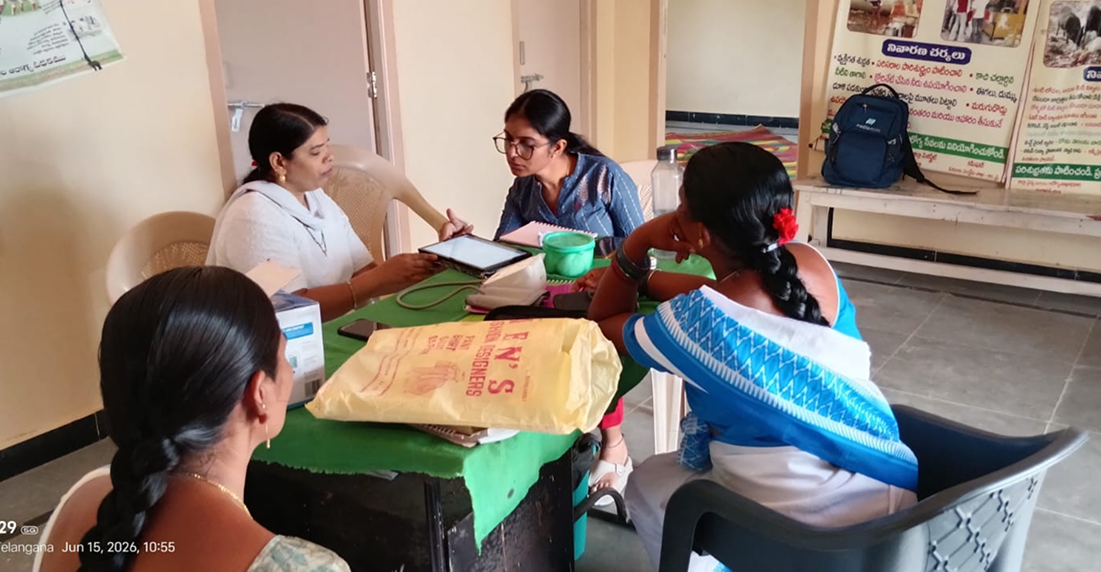
Population Health Management (PHM) is an approach to improving health outcomes by taking responsibility for the health of a defined population over time. It brings together prevention, early identification of health risks, appropriate care, follow-up and coordination across different levels of the health system.
The PHM project in Ranga Reddy district seeks to strengthen this approach within the existing health system. The project focuses on ensuring that people are proactively reached, health risks are identified early, appropriate care is initiated, and individuals who require continued or advanced care remain connected to the health system.
The project began in June 2026 and currently covers approximately 60,000 people across 21 villages. It will progressively expand to 100 villages covering approximately 300,000 people across Manchal, Yacharam, Ibrahimpatnam and Kandukur mandals of Ranga Reddy district, Telangana.
The approach works through existing health services and community platforms, strengthening the links between communities, primary healthcare and higher levels of care. It seeks to move healthcare from being predominantly responsive to illness towards a more proactive approach to managing the health of populations.
This creates continuity between community-level engagement, primary healthcare and higher levels of care. The emphasis is not on creating a separate system of care, but on strengthening how existing services work together around the needs of people and communities.
The project works through the existing public health system, with Primary Health Centres (PHCs) serving as the principal point of care for the population. Community-level engagement, prevention, screening and routine management are strengthened through the existing health-system structure, while the Community Health Centre (CHC) provides access to specialist care where required.
Individuals are assessed according to their health risks and care needs. Those requiring specialist or higher levels of care are supported through Care Coordination, helping them navigate appropriate providers, complete referrals and remain connected to care to ensure continuity throughout their care journey. Where appropriate services are not available within the public system, individuals can be supported to access quality-assured private providers based on quality and affordability. Existing financial protection mechanisms, including PM-JAY and other applicable options, are used wherever available to reduce financial barriers to care.
Community engagement extends beyond the health system. The project uses Self-Help Groups (SHGs) and has begun collaborating with the District Rural Development Agency (DRDA) to work with SHGs and their federations on health literacy and behaviour change communication (HL & BCC). It also works with Gram Panchayats to address determinants of health that extend beyond healthcare services.
The project is supported through internal resources and pooled funding from CSR and other donors, bringing these different elements together around the health needs of the defined population rather than creating a parallel delivery system.
The project commenced in June 2026 across 21 villages, covering approximately 60,000 people. It will progressively expand across Manchal, Yacharam, Ibrahimpatnam and Kandukur, reaching approximately 100 villages and 300,000 people.
As the project expands, the focus will remain on strengthening population identification, risk assessment, prevention, care coordination and continuity of care through the existing health system and community structures.
The project seeks to strengthen the ability of the health system to proactively identify people who need attention, connect them with appropriate services and support continuity of care over time.
It is expected to contribute to
The broader aim is to strengthen the health system’s ability to move from responding to individual episodes of illness towards proactively caring for the health of defined populations.