Governance

Labourers Empowerment Aid Programme (LEAP)

Ongoing | 2022- 2026

About

A multi-year, CSR-driven social protection initiative delivering accidental insurance, loss-of-wage support, and healthcare access to informal construction workers
Overview
  • Aggregate Enrolment: 32,134 workers
  • Work Sites Covered: 104
  • Builders Engaged: 10
  • Cities Reached: 16
  • Savings Generated for Workers: ₹91.5 lakhs
  • Aggregate Engagement Rate: 79%
  • Aggregate Utilisation: 33% (11% insurance, 22% outpatient)
  • Aggregate Renewal Rate: 62%
  • Ayushman Bharat: 12,210 workers checked for eligibility / 3,419 found eligible
InOrder partnered with HDFC Capital as part of the Labourers Empowerment Aid Programme (LEAP). a multiyear, multi-stakeholder initiative designed to address the lack of financial and health protection for informal construction workers. Launched in 2022, LEAP evolved into a scalable, CSR-driven social protection model delivering:

  • Accidental coverage: enrolment in a funded accidental insurance programme covering hospitalisation, disability, and death.
  • Loss-of-wage coverage: compensation for enrolled workers hospitalised due to any illness.
  • Government health scheme linkage: awareness and enrolment support for Ayushman Bharat.
  • Teleconsultation access: 24/7 doctor consultations to drive engagement and utilisation.


Over four years, LEAP transitioned from a pilot intervention into a multi-city programme embedded within construction ecosystems – demonstrating that low-cost, employer-linked, CSR-funded models can deliver high-impact outcomes at scale.
India’s construction sector is one of the country’s largest employers of informal labour and a critical backbone of urban and infrastructure development. Yet a significant share of workers is unregistered, contract-based, and exists outside formal worker protection systems. Large-scale migration between sites, cities, and states disrupts documentation, continuity of benefits, and access to government schemes. A substantial portion of the workforce works on a daily wage basis, with limited access to savings, credit, and insurance; meaning even short disruptions can cause immediate financial stress.

Construction sites are high-risk environments, exposing workers to falling objects and equipment-related injuries. On top of this, workers and their families face health risks stemming from poor hygiene and living conditions, limited preventive care, and treatment delays due to cost concerns. Even minor illnesses, when left untreated, can escalate into serious conditions requiring hospitalisation. In such scenarios, workers face a dual burden — the direct cost of medical care and the indirect loss of wages during recovery. A single adverse event can trigger a cascade of out-of-pocket expenditure, income loss, borrowing, and long-term financial instability.

Traditional insurance models have proven inadequate for this population because they are not designed for informal, mobile workers. They rely on individual enrolment with identity verification, detailed data capture, and stable contact information – processes that are documentation-heavy and lead to low adoption. Even when workers are enrolled, upfront premium payments pose a significant barrier, and claims processes are often complex.

  • Workers are unable to afford or navigate protection systems.
  • Insurers require structured data and predictable risk pools.
  • Employers lack direct incentives to invest in worker protection.
  • Government schemes struggle with last-mile delivery.
LEAP was conceptualised on the hypothesis that insurance and healthcare services would see significantly higher adoption if delivered with minimised cost and complexity. The programme progressed through three design stages:

  • Named insurance model — individual enrolment; proof of demand.
  • Unnamed group coverage model — site-level activation; rapid scale. Builders could extend coverage to an entire workforce without pre-registration; worker details were captured only at the time of claim initiation.
  • Refined engagement — improved field processes; expansion to more sites.


This evolution was central to LEAP’s ability to serve a highly mobile migrant workforce.
Personal Accidental Insurance
  • 2022–2024: Up to ₹1 lakh for accidental death, Permanent Total Disability (PTD), or Permanent Partial Disability (PPD).
  • 2024 onward: Increased to ₹5 lakhs for death, PTD, or PPD; plus accidental hospitalisation coverage up to ₹50,000.


Loss-of-Wage Coverage
  • Cash allowance of ₹500 per day of hospitalisation (minimum 24 hours), for a maximum of 10 days per year.
  • Covers any kind of illness — not limited to accidents.


Doctor Consultation on Phone
  • Unlimited, 24/7 teleconsultation with experienced General Physicians (MBBS, 5+ years) via WhatsApp, in multiple languages — no app downloads required.


Ayushman Bharat – Public Health Insurance Linkage
  • Eligibility checks, enrolment card generation, and network/process support.

Funding: Product costs were funded by HDFC Capital CSR, together with contributions from participating developers and builders.
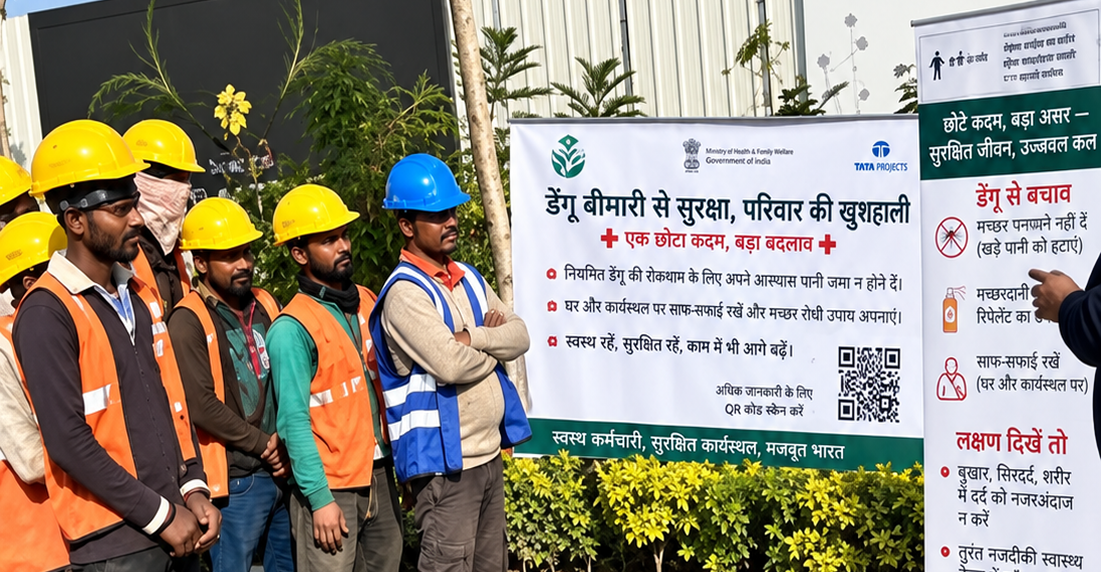
The programme used WhatsApp-based communication to share practical health guidance on topics like box-breathing for stress management and dust protection, hydration practices, keeping workers connected to the services available to them. Field teams conducted regular site visits across construction locations to facilitate enrolment, reinforce awareness, and maintain the human connection that underpinned the programme’s high engagement rate.

Year-by-year growth:

Year Builders Sites Covered Cities Covered Workers Engaged
2022–23 2 39 2 2,120
2023–24 3 26 2 2,124
2024–25 7 86 16 17,890
2025–26 4 20 3 10,000

Aggregate enrolment: 32,134 workers.

Key outcomes:

  • Savings generated for workers: ₹91.5 lakhs
  • Aggregate utilisation: 33% (11% insurance, 22% outpatient)
  • Overall engagement rate: 79%
  • Ayushman Bharat linkage: 12,210 workers checked for eligibility; 3,419 found eligible

Over four years, LEAP established a replicable template for informal worker protection:

  • Low-cost, CSR-driven models can deliver high-impact social protection at scale.
  • Unnamed group coverage removes the onboarding friction that defeats traditional insurance for mobile, undocumented workers.
  • Multi-stakeholder ecosystems – anchor funder, health-systems designer, execution partner, and employers – are key; no single actor can close this gap alone.
  • Continuous engagement and successful claims facilitation build the trust needed for workers to transition into self- or employer-paid renewal models.
  • WhatsApp-first delivery (aligned to how workers actually communicate) can sustain very high engagement without requiring new apps or digital literacy.